


Lithium vs Lead-Acid Jump Starters: Which Technology Is Better?
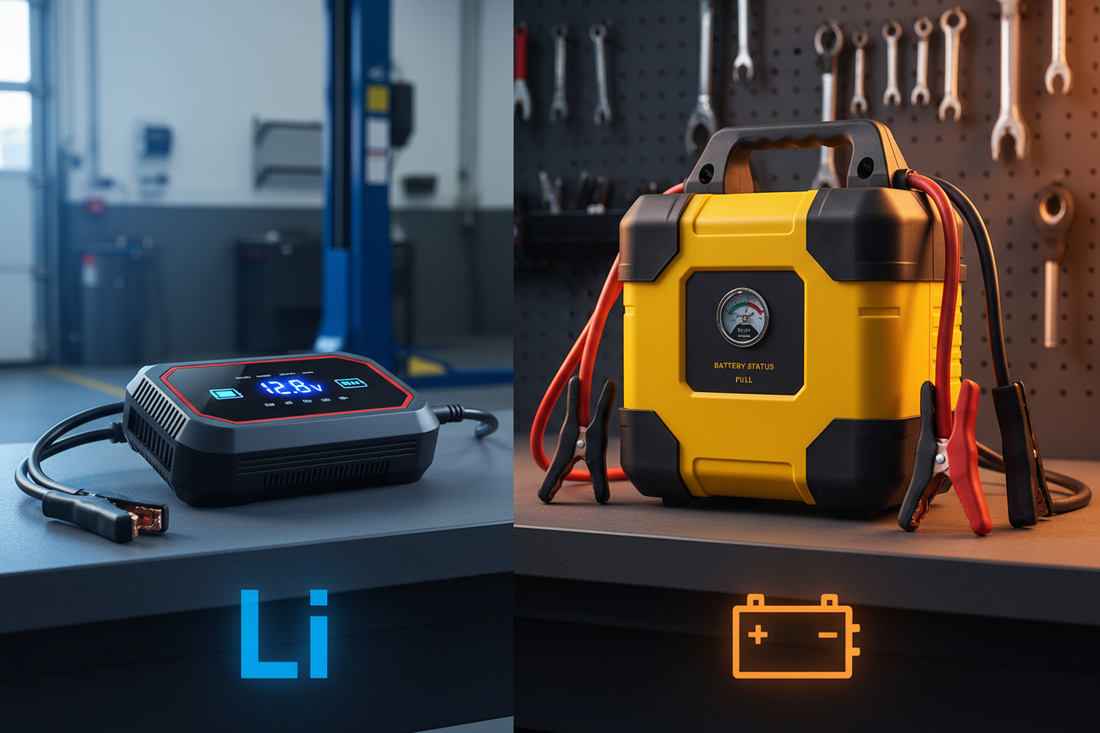
Walk into any auto shop and you will see two types of jump starters. One is compact, lightweight, and modern. The other is bulky, heavy, and old-school. The difference is not just size. It is the battery technology inside.
Lithium-ion and lead-acid jump starters both do the same job, but they do it very differently. One holds charge for months, the other loses power sitting on the shelf. One weighs less than a kilo, the other can weigh 10 kilos or more.
This guide compares lithium vs lead-acid jump starters across power, storage, safety, cost, and real-world performance so you can choose the right technology for your needs.
Quick Comparison: Lithium vs Lead-Acid Jump Starters
Here is the summary before we dig into the details.

| Feature | Lithium-Ion | Lead-Acid |
| Weight | 0.5-1.5 kg (ultra-portable) | 5-15 kg (heavy, bulky) |
| Size | Fits in glovebox | Requires boot space |
| Charge retention | Holds charge 6-12 months | Loses charge in 1-3 months |
| Cold weather performance | Reduced below 0°C | Better in extreme cold |
| Lifespan | 3-5 years, 300-500 cycles | 3-5 years, fewer cycles |
| Upfront cost | Higher ($100-$400) | Lower ($50-$200) |
| Safety features | Built-in protections standard | Basic or none |
| Best for | Daily drivers, commuters, portability | Workshop use, extreme cold, budget |
Power Output: Can Lithium Match Lead-Acid?
Lead-acid jump starters have a reputation for raw power. They can deliver very high cranking amps, which is why workshops and heavy-duty users have relied on them for decades.
But modern lithium-ion jump starters have closed the gap. High-quality lithium units can deliver 1000A to 2000A of cranking power, which is enough for most petrol and diesel engines, including utes and 4WDs.1
The key difference is sustained output. Lead-acid batteries can maintain high current for longer periods, which can be useful for very large diesel engines or repeated jump attempts. Lithium batteries deliver strong bursts but may struggle with extended cranking on extremely large engines.
For most Australian drivers, lithium power is more than enough. If you drive a standard petrol or diesel vehicle up to 3.0L, a quality lithium jump starter will handle it easily. For heavy-duty diesel 4WDs or commercial vehicles, read our guide on How to Select the Best Heavy Duty Jump Starter.
Weight and Portability: Lithium Wins by a Mile
This is where lithium-ion dominates. A typical lithium jump starter weighs between 500 grams and 1.5 kilograms. You can store it in your glovebox, under the seat, or in a door pocket.
A lead-acid jump starter can weigh 5 to 15 kilograms. It takes up serious boot space and requires two hands to carry. If you need to walk to a stranded car or help someone in a car park, the weight difference matters.
For commuters, families, and anyone who values convenience, lithium is the clear winner. For workshop or fleet use where the unit stays in one place, weight is less of an issue.

Charge Retention and Storage: Lithium Holds Power Longer
One of the biggest advantages of lithium-ion technology is charge retention. A quality lithium jump starter can hold its charge for 6 to 12 months when stored properly.2
Lead-acid batteries self-discharge much faster. Even a new lead-acid jump starter can lose significant charge in 1 to 3 months, especially in hot conditions. If you leave it in the boot over summer, it may be flat when you need it.
This makes lithium ideal for emergency use. You can charge it once, throw it in the car, and trust it will work months later. Lead-acid units need regular recharging, even if you never use them.
For more on how to maintain your lithium jump starter and maximize charge retention, read our Understanding Lithium State of Charge guide.
Cold Weather Performance: Lead-Acid Has the Edge
Lithium-ion batteries lose performance in cold temperatures. Below 0°C, lithium cells can lose 20-40% of their capacity, and some units may refuse to operate below -10°C to protect the battery.3
Lead-acid batteries also lose capacity in the cold, but they handle extreme cold better than lithium. This is why lead-acid is still preferred in very cold climates like Canada, Scandinavia, and high-altitude regions.
For most of Australia, this is not a major concern. Even in alpine areas like the Snowy Mountains or Tasmania in winter, temperatures rarely drop low enough to seriously affect lithium performance. But if you regularly drive in sub-zero conditions, a lead-acid unit or a lithium unit with cold-weather protection is worth considering.
If you are unsure which voltage system your vehicle uses, check our guide on 12V vs 24V Jump Starters.
Lifespan and Durability: Both Last 3-5 Years
Lithium-ion jump starters are rated for 300 to 500 charge cycles, which translates to 3 to 5 years of typical use.4 After that, the battery capacity degrades and the unit may not hold enough charge to start your car reliably.
Lead-acid jump starters have a similar lifespan, though they tend to degrade faster if not maintained properly. Lead-acid batteries need regular recharging to prevent sulfation, a process where lead sulfate crystals build up and reduce capacity.5
In practice, both technologies last about the same amount of time if you follow proper storage and maintenance. The difference is that lithium requires less maintenance, while lead-acid needs more attention to stay healthy.
Safety Features: Lithium Units Are Smarter
Modern lithium jump starters come with built-in Battery Management Systems (BMS) that provide multiple layers of protection:6
- Reverse polarity protection (prevents damage if you connect backwards)
- Over-current protection (shuts down if current draw is too high)
- Over-voltage protection (prevents voltage spikes)
- Short-circuit protection (cuts power if clamps touch)
- Temperature protection (shuts down if the unit overheats)
- Spark-proof technology (prevents sparks during connection)
Lead-acid jump starters typically have fewer or no built-in protections. You rely on correct procedure and external fuses to prevent damage. This makes lithium units safer for inexperienced users or emergency situations where you might be stressed or rushed.
For a full breakdown of safe jump starting procedures, read our Safe Way To Use a Portable Jump Starter: Expert Guide.

Cost Comparison: Upfront vs Long-Term Value
Lead-acid jump starters are cheaper upfront. You can find basic units for $50 to $100, with heavy-duty models ranging up to $200.
Lithium jump starters cost more, typically $100 to $400 depending on capacity and features. High-end models with extra USB ports, air compressors, and large batteries can cost even more.
But cost is not just about the purchase price. Consider:
- Maintenance: Lead-acid units need regular recharging, even when not in use. Lithium units can sit for months without attention.
- Replacement frequency: Both last 3-5 years, but lithium units are more likely to reach the upper end of that range with less maintenance.
- Convenience: The portability and reliability of lithium can save you time, stress, and roadside assistance fees.
Over the life of the product, lithium often delivers better value despite the higher upfront cost. For a full buying guide that considers cost and value, see our Portable Jump Starter Buying Guide: 2026 Edition.
Environmental Impact: Lithium Is More Efficient
Lithium-ion batteries are more energy-efficient than lead-acid. They charge faster, lose less energy to heat, and require fewer charge cycles over their lifespan.7
However, lithium mining has environmental and ethical concerns, particularly around cobalt extraction. Lead-acid batteries are highly recyclable (over 95% of lead-acid batteries are recycled in developed countries), but lead itself is toxic.8
Both technologies have environmental trade-offs. The best choice is to buy a quality unit that lasts, maintain it properly, and recycle it responsibly at end of life.
Who Should Buy Lithium?
Lithium jump starters are best for:
- Daily commuters who want a compact, reliable emergency tool
- Families who need something easy to store and use
- Drivers who want long charge retention and low maintenance
- Anyone who values portability and modern safety features
- Petrol and diesel vehicles up to 3.0L (with the right amperage)
If you want the most convenient, modern solution and are willing to pay a bit more upfront, lithium is the way to go.
Who Should Buy Lead-Acid?
Lead-acid jump starters are best for:
- Workshop or fleet use where the unit stays in one location
- Drivers in extreme cold climates (sub-zero regularly)
- Heavy-duty diesel engines that need sustained high current
- Budget-conscious buyers who do not mind the weight and maintenance
- Users who already have a charging routine and storage space
If you need maximum power for large engines or operate in very cold conditions, lead-acid is still a solid choice.

Hybrid Options: Best of Both Worlds?
Some manufacturers offer hybrid jump starters that combine lithium-ion cells with capacitor technology. These units use capacitors to deliver very high peak current while the lithium battery provides sustained power.
Hybrid units can be a good middle ground, offering strong performance in cold weather and high power output in a relatively compact package. However, they are less common and can be more expensive.
Final Verdict: Which Technology Is Better?
For most Australian drivers, lithium-ion is the better choice. It is lighter, more convenient, holds charge longer, and comes with better safety features. The higher upfront cost is offset by lower maintenance and better long-term reliability.
Lead-acid still has a place for heavy-duty use, extreme cold, and budget-conscious buyers who do not mind the weight and maintenance requirements.
The best jump starter is the one that matches your vehicle, your driving conditions, and your usage patterns. For more guidance on choosing the right unit, explore our guides on how many amps you need, how auto jumpers work, and our comparison of Lithium vs Lead-Acid Car Batteries.
References
- Battery University. (n.d.). Types of Lithium-ion Batteries. Battery University.
- Battery University. (n.d.). How to Store Batteries. Battery University.
- Battery University. (n.d.). Discharging at High and Low Temperatures. Battery University.
- Battery University. (n.d.). How to Prolong Lithium-based Batteries. Battery University.
- Battery Council International. (2022). Lead-Acid Battery Technology. Battery Council International.
- UL. (n.d.). Portable Power Pack Testing - UL 2743. UL.
- Argonne National Laboratory. (2021). Lithium-Ion Battery Recycling. U.S. Department of Energy.
- Battery Council International. (2023). Battery Recycling Statistics. Battery Council International.